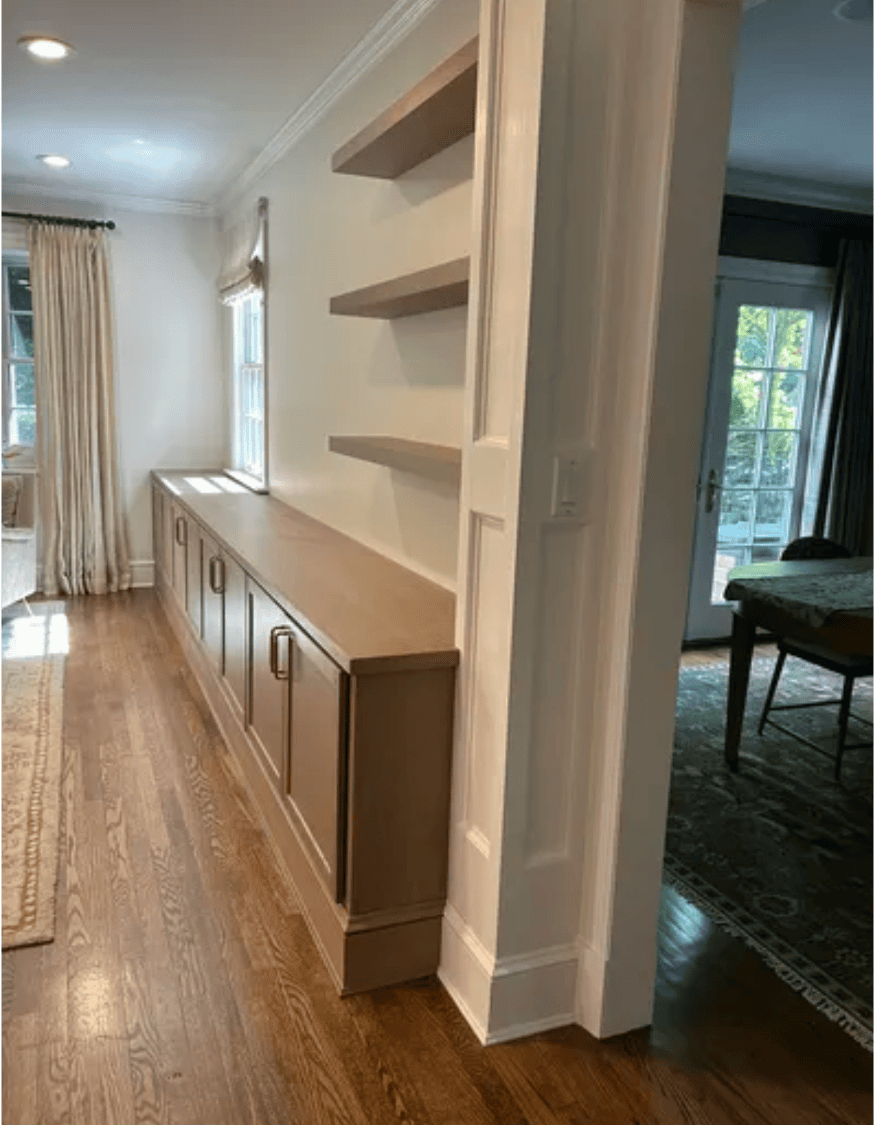
What Should Custom Built-In Furniture Cost in New York City?
An Honest Guide from a Professional Cabinetmaker
One of the questions I’m asked most frequently by prospective clients is also one of the most difficult to answer: “What should custom built-in furniture cost?” It’s a reasonable question, and one that deserves a transparent answer.
Why Does Custom Cost More?
The challenge is that custom furniture sits somewhere between architecture, construction, design, and manufacturing. Buying a sofa from a retailer is one thing. Commissioning custom built-ins means hiring someone to design, build, finish, and install a piece that exists nowhere else in the world and, ideally, stays part of your home for decades. That level of customization creates a wide range of possible costs. Still, after years of building custom furniture throughout New York City and the surrounding region, I’ve found that most projects fall into a fairly predictable range.
Ok – So What Should I Expect?
For the projects I build most often, built-in libraries, home offices, media walls, architectural millwork, and custom cabinetry integrated into existing homes, a realistic investment often falls between $6,000 and $30,000. Smaller projects sometimes make sense, and larger ones are certainly possible. But that range is typically where custom work delivers real value while still supporting the craftsmanship and finish quality clients expect.
This isn’t meant to convince you that custom furniture is always better than manufactured furniture. In plenty of situations, custom isn’t the right answer. My goal is simpler: to explain what you’re actually getting when you invest in custom built-ins, and why the cost often looks different than what people expect.
You’re Not (Just) Buying Furniture
One of the most helpful ways to understand custom built-ins is to recognize that you are not really purchasing furniture in the traditional sense.
When you buy a manufactured bookcase or media console, you’re buying an object designed once, engineered once, manufactured thousands of times, and distributed through a highly optimized supply chain. Every detail, from dimensions to materials to packaging, has been refined to cut cost and maximize scale. Each one of the thousands of identical pieces of furniture includes a very small portion of that design and planning. Custom furniture works under a completely different model.
Every custom project starts with a conversation. Dimensions are measured for your home specifically. Design decisions are based on your home’s architecture, your storage needs, your aesthetic preferences, and how your family actually lives. Materials are chosen for the specific application. Construction methods are chosen to balance appearance, durability, and performance. Then the piece is fabricated, finished, installed, and calibrated for one client and one location only.
In other words, custom built-ins resemble a small architectural project more than a retail furniture purchase. Once clients begin thinking about custom furniture in those terms, the economics become much easier to understand.
Design Is Part of the Product
One of the most important and least obvious components of excellent custom woodwork is design. When people imagine custom cabinetry, they often picture someone cutting wood and assembling boxes. In reality, a substantial portion of the value is created long before any material enters the workshop.
Successful projects require decisions about proportions, functionality, storage requirements, architectural integration, material selection, hardware specification, lighting, accessibility, and installation methods, among other factors. Those decisions affect how the project looks on installation day. They also affect how it functions years or even decades later. A built-in library, for example, isn’t simply a collection of shelves. Shelf depth and spacing, load capacity, lighting integration, and overall proportion all determine whether the finished piece feels merely adequate or genuinely exceptional.
Similarly, a home office is not simply a desk surrounded by cabinetry. It is an environment designed to support concentration, productivity, and daily routines. Good design often feels effortless. Achieving that effect rarely is.
Materials Matter, But Perhaps Less Than You Think
Prospective clients sometimes assume that material cost is the primary driver of custom furniture pricing. While materials certainly matter, they typically represent a much smaller percentage of the overall project cost than most people expect, often only 10-15%.
The furniture-grade plywood, hardwood lumber, hardware, and finishes used in a custom project can represent thousands of dollars. But the bigger investment is the skilled labor, expertise, and carefully maintained infrastructure needed to turn those materials into a finished installation. A Stradivarius violin isn’t valuable because of the wood. In the same way, clients aren’t hiring a custom cabinetmaker because plywood and hardwood are hard to buy. They’re hiring someone to apply years of experience, judgment, and problem-solving to those materials.
The Hidden Work Is Often the Most Important Work
One of the realities of custom woodworking is that much of the labor clients pay for is effectively invisible. They see beautifully finished surfaces, precise joinery, carefully integrated lighting, and cabinetry that appears to fit effortlessly within the home’s architecture. But they don’t necessarily see the many decisions that are essential to producing that result.
Materials must be selected, milled, sanded, finished, assembled, and installed. Drawers must operate smoothly. Doors must align properly. Reveals must remain consistent. Finish quality must withstand close inspection under both natural and artificial light. In my experience, clients often appreciate these details most, not on the day of installation, but years later, when the furniture continues to function exactly as intended.
Why Installation Matters More Than Most People Realize
One lesson I’ve learned is that fabrication and installation deserve equal respect. Beautiful cabinetry loses much of its impact if installation is rushed or treated as an afterthought. Making built-ins look like they’ve always belonged in a home takes real time: adjusting door alignment, calibrating drawer fronts, refining reveals, and integrating the work into the home’s existing architecture.
This is especially true in New York City and the surrounding region, where older homes often bring architectural conditions that are anything but straightforward. Walls are rarely perfectly flat. Floors are rarely level. Existing trim, plaster, and historical details often require careful adaptation and real patience.
Why New York City Is a Particularly Challenging Market
Any honest discussion of custom furniture pricing has to acknowledge the realities of building in New York City, Westchester, Long Island, and northern New Jersey. Workshop space is expensive. Real estate is expensive. Insurance is expensive. Transportation is expensive. Skilled labor is expensive. Finishing facilities, professional-grade equipment, dust collection, climate control, and commercial vehicles all represent real investments. Meanwhile, clients rightly expect a very high standard of execution.
The result is that producing truly custom work in this region requires a level of infrastructure, expertise, and commitment that can be difficult to appreciate from the outside. This isn’t a complaint. It’s simply the economic reality of producing high-quality work in one of the world’s most demanding markets.
The most important point here might be that custom furniture isn’t always the right answer, especially in the NYC metro market. If a manufactured product already solves your problem well, buying it is often the smarter decision. If the budget makes custom work uncomfortable, there’s no shame in choosing another path. Plenty of excellent manufactured and semi-custom products exist, and I often point prospective clients toward them.
When Is Custom Furniture a Good Investment?
Custom furniture tends to make the most sense when one or more of the following are true:
- Existing furniture options have proven unsatisfactory.
- The space has unusual dimensions or architectural constraints.
- The project requires integration with existing architecture.
- Functionality is highly specific to the homeowner’s lifestyle.
- The client expects to remain in the home for many years, and long-term durability matters.
In these situations, custom work often becomes less of a luxury purchase and more of a long-term investment in the quality of daily life.
What Clients Are Really Investing In
When clients hire Hardwood Alchemy to build a library, home office, media wall, or custom millwork installation, they aren’t simply purchasing the inputs. They’re investing in design, craftsmanship, professional communication, careful planning, specialized equipment, years of experience, and a process built to produce work that feels like it has always belonged in their home.
Perhaps most importantly, they’re investing in the idea that the spaces we inhabit every day shape our quality of life in meaningful ways.
Custom furniture is a significant investment, and we recognize that. Having spent years in finance before becoming a professional woodworker, I understand the importance of evaluating investments carefully and thoughtfully.
For the right project and the right client, thoughtfully designed and carefully executed custom furniture offers something hard to find elsewhere. It’s the chance to create a space that’s uniquely your own, built for the way you actually live. And done well, it stays part of your home for decades to come.

